
MANMOSA - THE BELT BUCKLE
The 8 year backstory to The Belt Buckle
Video 1 (watch here)

VIDEO 1 of 5 Welcome to a project that: no one has asked for, has never left my mind, has been my focus on and off for about 8 years now. I am finally allowing myself to be excited. At this moment it feels like I just finished an exhausting college capstone project and I am now presenting it to you, the professors. It started as a novelty but as each version got better and more useful, I realized I was on a quest for this “thing.” A few years ago I reached a stopping point with the last version because it was just too hard to get the precision I needed though silicone molds. Andrew and I wore my last version of this thing almost everyday for about 4 years, and I knew that one day I had to figure out how to make this thing sellable and well… not ugly. When Chris first started with mimosa a few years back and learned about the thing, he said why don't we try to 3D print it in a castable resin, I said “hunh?” So like a turd of hurdles, we started to learn 3D resin printing and Fusion 360. This was the eureka moment, when I realized it can be done, but talk about a learning curve. Like seriously…I feel this has been the most challenging project I have ever worked on…ever…nothing compares. In 2025, I’ve had this thing ready to release to the public a few times, but pulled the cord because I realized at the last second it just wasn't quite right. This is the moment though, where I can 100% confidently stand behind this thing. So, this week I will be posting some quick videos synced up with songs I like that I felt represent the feeling and journey of going through all the motions of figuring this thing out, because that's showbiz baby. I hope you enjoy it.
Video 2 (watch here)

VIDEO 2 of 5 Please excuse my acting - I blame Madeline, lol. She said I 10,000% HAD to create some kind of visual representation to explain just how much trial and error this has been… so here you go… I know it's cringe but I'm just imagining myself explaining all this to my grandmas. Let me tell you, Fusion 360 was no cake walk to learn. In the beginning it felt painfully slow. Designing something on a computer, printing it, then holding that version just to see how it feels or fits together would take about two weeks each time I changed anything. We did this over and over and over and over again. I’m sure there are better ways to design, machine, or mill something like this. But given the challenge, the tools, the materials and the mindset we already use with lost wax casting, it was the method that evolved. Before I knew it, I was deep into component organization, 0.1 millimeter clearances, projecting sketches, realizing to not worry about too many sketches, combining bodies, creating meshes and .obj’s, experimenting with custom support strategies instead of the traditional print supports, which was all insanely frustrating to dial in. I’m really glad I finally… sorta… kinda… feel proficient in Fusion 360 now, but damn, what a journey. Hours and days of YouTube videos. Meanwhile, Chris was battling adhesion to the build plates, exposure times, FEP film punctures and replacements, layer separations, temperature swings, and failed prints. So many failed prints. Every time we made an adjustment we’d think, “This HAS to work now!” but the printers would declare otherwise. But there was always one moment….one specific print….where it felt like we finally graduated from not knowing what the hell we were doing… to a tiny door cracking open to a sliver of light.
Video 3 (watch here)

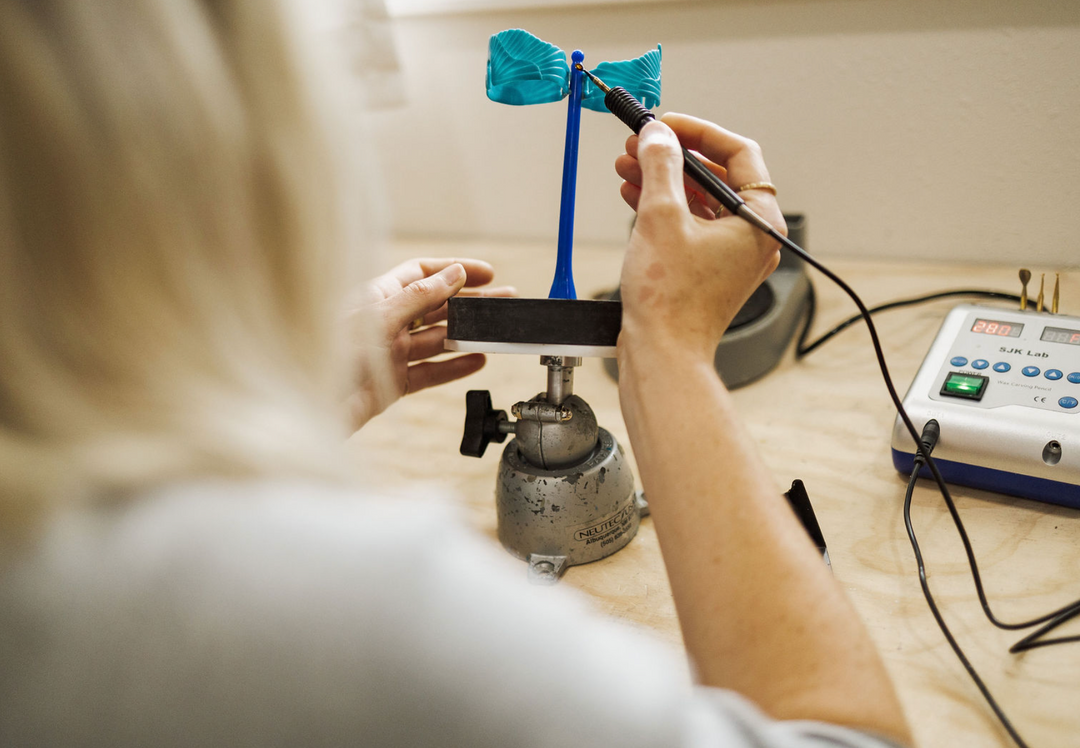
VIDEO 3 of 5 Patience is something I’ve always struggled with and I feel this thing has officially somehow “leveled me up” as a “zen patience master.” Not really, but this project definitely helped. Ok, apologies for what i’m about to explain, I know most of you might clock out with what im talking about, but i gotta… Once we started casting the prints, the first thing I found out using traditional print supports was that once cast into metal there would always be a blemish or pit where the tiny print frame support touched the piece. In my mind this presented another road block, the metal was tough to smooth on flat surfaces, and it looked like it had tiny bumps or holes all over the metal where the printed supports were previously attached. It looked terrible and required a ton of refining. So I thought about it for a while and came up with “wafer” supports, as I dubbed them, printed along with the sprues that would be needed to cast each piece in a way that is not noticeable. It also helped with not having to angle the print in two axis, just one tilt. Print lines were then perfectly straight as well, and that makes me happy. It's basically just “bridging” the gaps between “islands” with a thin wafer line instead, and any flat islands parallel to the build plate would be built and secured starting all the way from the very first print layer. These thin wafers, keeping edges perfectly straight, can then be easily sliced away with an ultrasonic knife. It's actually almost satisfying to do. Dialing in this support style has really mainly helped with printing geometric shapes. It's like slicing out a puzzle each time, still labor intensive, but they cast decent and buff easily. One more piece of the puzzle down.
Video 4 (watch here)

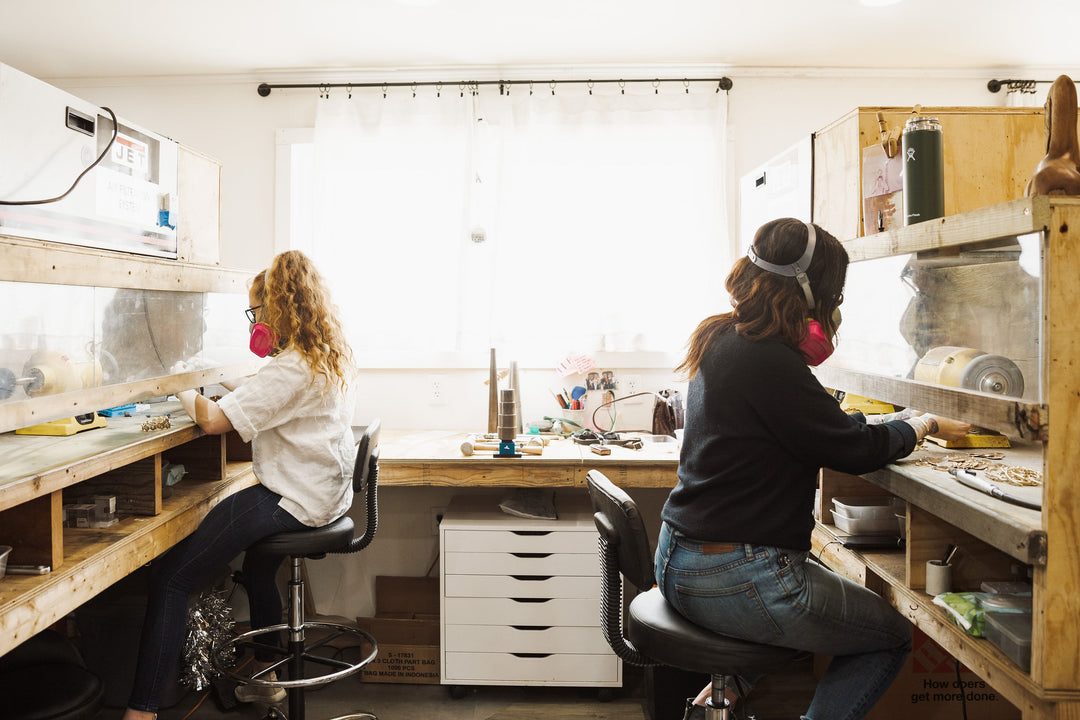
VIDEO 4 of 5 Once we got to this part of the project, it was second nature, kinda… actually, not really at ALL… it was hard as hell to figure all of this out too… so frustrating… the damn casting part. However, I do love the casting part. I feel we had this part of the process pretty darn down pat, although historically our overall casting success rate over 11 years is 90%, and I don't know if that's good or bad, but it seems good to me I guess, ha! When it's going well, this part just feels like pure magic. In theory this part is so easy. Anyone who has ever cast knows its muscle memory, in this part your heart never stops racing till you finally memorize the sequence and you can do it without thinking. We cast about 30 flasks of jewelry a week, and each flask feels like these little intense 3 minute situations. Will it work, will I drop the flask, will it pull a vacuum, will the metal blow out, did the pieces form, will the crucible shatter into a splash of molten bronze on my feet? Nothing you can do about it either, just labor lost. But when it does work, it finally feels like a sense of creation. Anyway, I digress, back to the belt buckle, we did have a few things to figure out, actually maddening things! Figuring out the investment powder specifically for resin, cleaning resin pieces perfectly before investing, different burnout schedules and temps, sticking to STRICT formulas and times, keeping print pieces in a dehumidifier, making sure resin pieces were perfectly clean, stacking flask in the kiln just right, accepting imperfections from the burn out sequence, etc... Once we painstakingly dial in the cast, the pieces buffed so much easier, assembly times were starting to come to light, roadblocks were opening, and finishing this project was starting to feel more about small details, even though one specific exciting detail probably took me a year to dial in, which you will see in tomorrow's final video :)
Video 5 (coming soon)

VIDEO 5 of 5 Listen to me show off “The Belt Buckle”. This model is “The Engraved One”, and I always envisioned this thing having a laser engraved paisley gun stock design, so if you're into old cars, then you will understand this is the “dolled-up” version. The Belt Buckle can accept any 1.5” belt, however we encourage purchasing a beautiful handcrafted belt made in house by Dead on Decatur in New Orleans. We try to keep most sizes and two different browns in stock at all times. They also fit most of our other belt buckles styles. “The Belt Buckle” has three attachments that each have stainless steel spring loaded bronze clips that snap into place. No falling out. The first attachment is “The Stash”, which is a small concealed compartment for everyday carry. I try to keep about 4 twenty dollar bills rolled up in there since I never really have cash on hand, or in this case… sparklers to celebrate being done! It has a door that is friction fitted and can be adjusted over time for snug closing. The next attachment is “The Tools” which consist of a bottle opener with phillips screw driver, and a knife. I designed the screwdriver and bottle opener computer file and had them laser cut out of 14 gauge stainless steel by oshcut in Utah. The knife is set up to accept #10 surgical blades, and the blades can easily be changed out as they dull with the pliers provided. The last attachment…and the one that took me forever, is “The Lighter.” This is a wick style lighter and accepts regular lighter fluid, which I include a can with each belt. The fluid typically lasts about 2-3 weeks, or expect about 30-40 strikes before drying. It is great for a weekend in the woods. It goes without saying, the lighter took me the most time to figure out, and I could not move on till it worked or held the lighter fluid for more than a week. I probably went through about 10 designs before I found the one I was totally satisfied with, and I’ll show you all those older designs another day. The main hurdle to overcome with a wick style lighter is fluid evaporation, but this model has lasting power due to the o-ring seal! It's also very easy to refill and easy to change out used flints, I'll show that on another day as well. So that's the quick tour, I hope you like it, it feels great to finally show the final project! I can honestly say I wear this thing every day, as it was engineered to last. Just saying… It would make one hell of a gift to yourself or someone you like. We’d love for you to swing by the joint and check it out in person, 541 S. Eugene St, 70806 :)
Watch the full demonstration of how it works here!